
JOSEPH A. ADE
ATLANTIC CITY, NEW JERSERY 1932–2025
- Branch of service
- United States Marine Corps
- Primary military occupation
- Sniper
- Highest rank achieved
- Sergeant
- Dates of service
- 1951 – 1956
- Wartime unit
- Company B, 1st Marine Regiment, 1st Marine Division
- Campaign awards
- UN Summer-Fall Offensive, Second Korean Winter
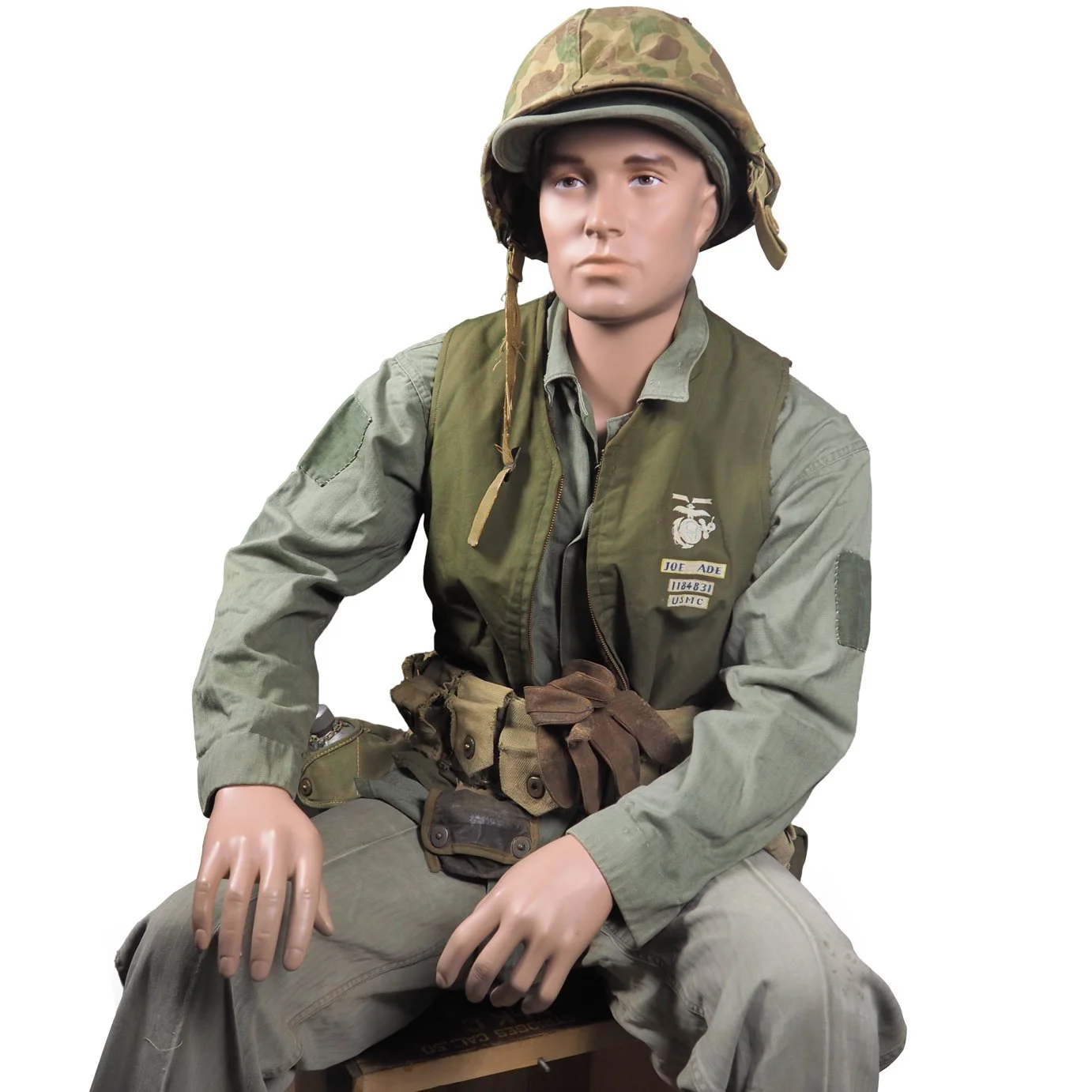
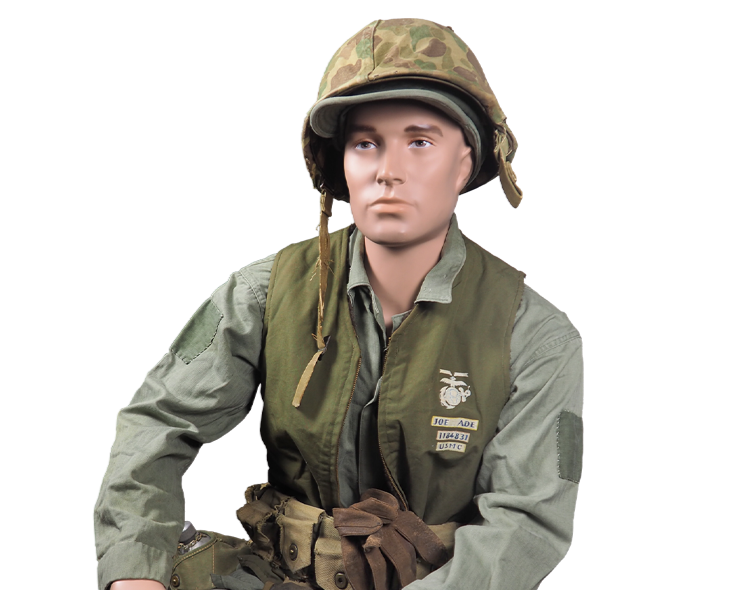
Everything pictured here was issued to Sergeant Ade, with the exception of the M1 helmet and canteen sets. It is quite remarkable to find this much kit used by one man.
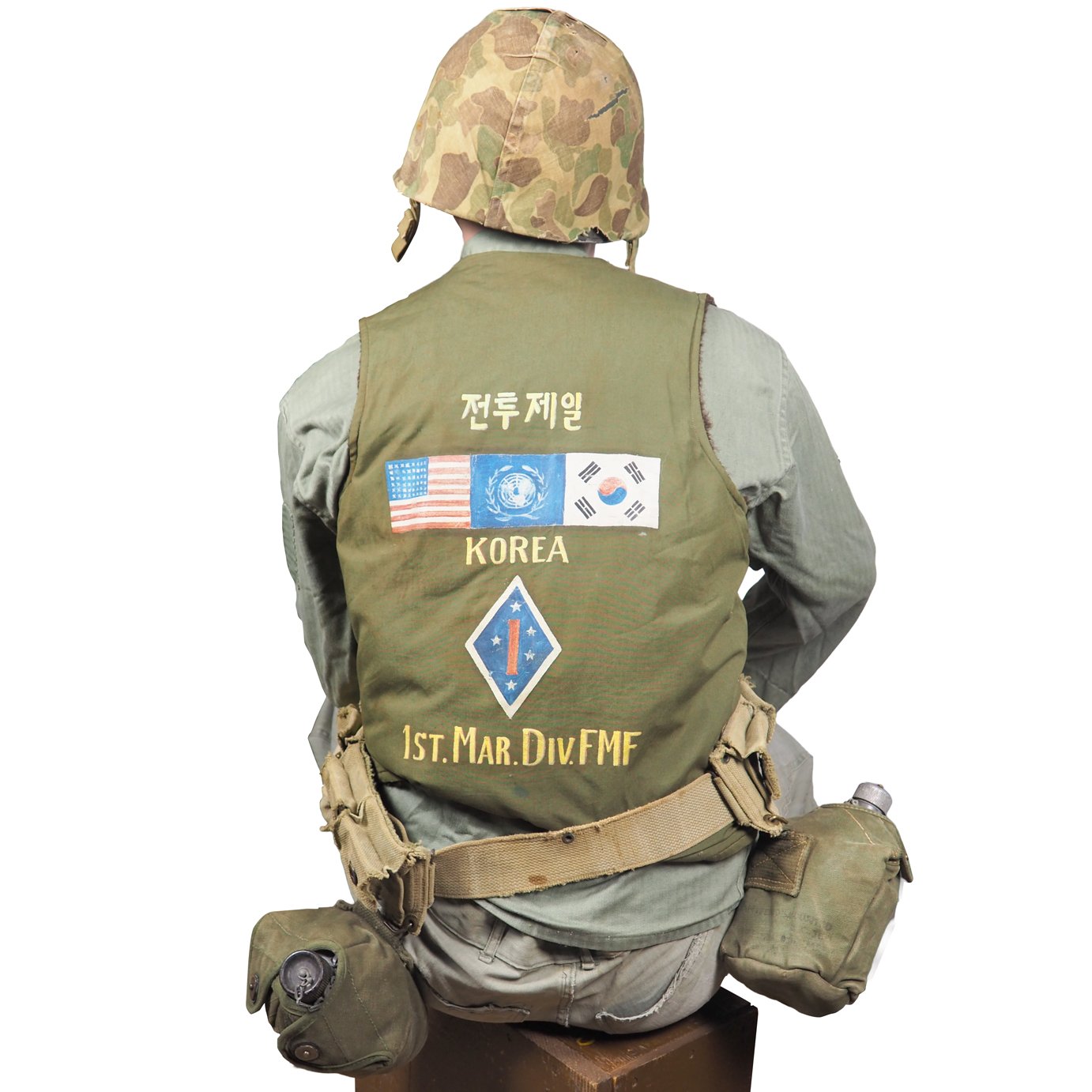
The beautifully executed souvenir alpaca lined vest Sgt Ade took home from Korea.
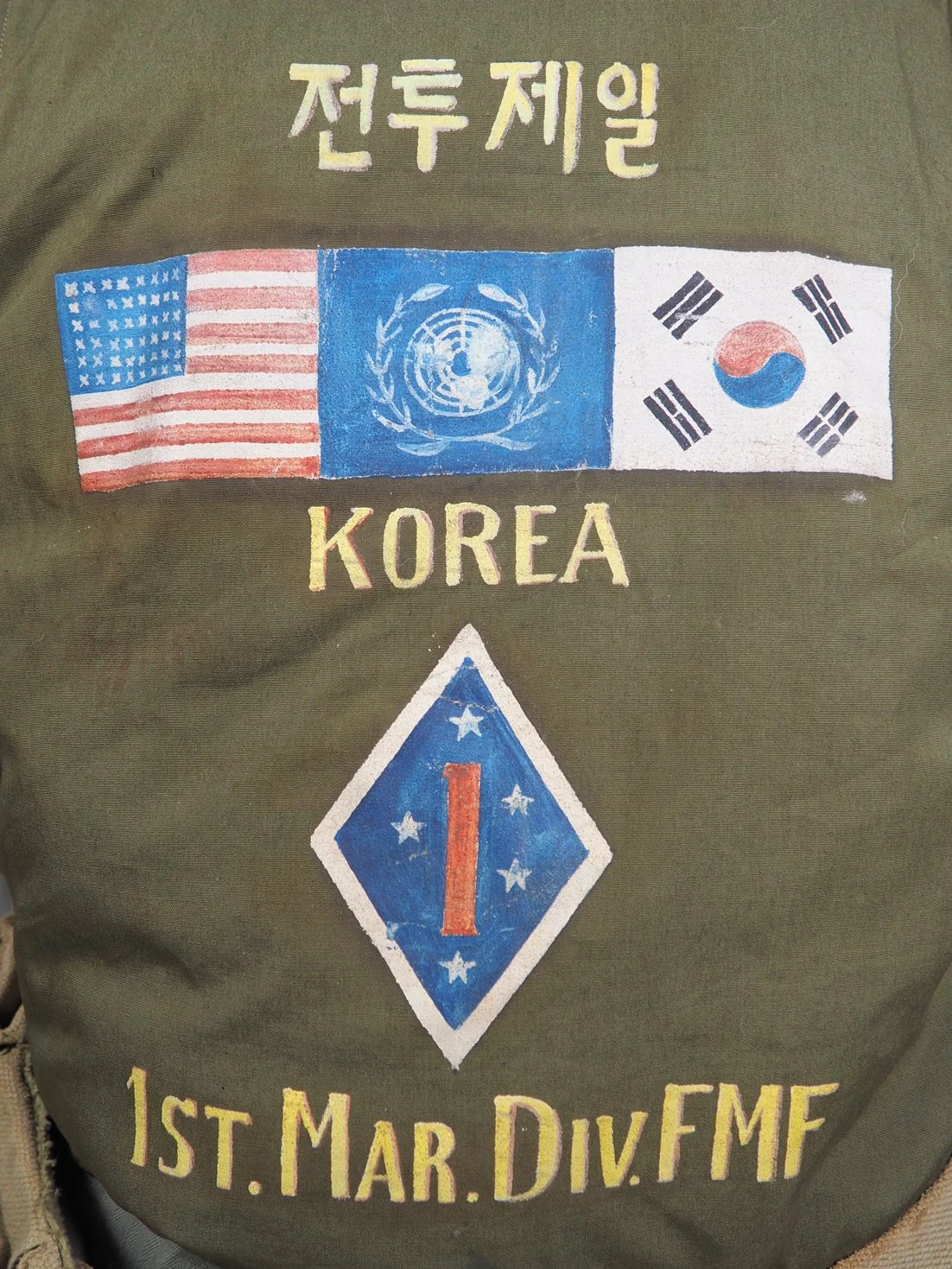
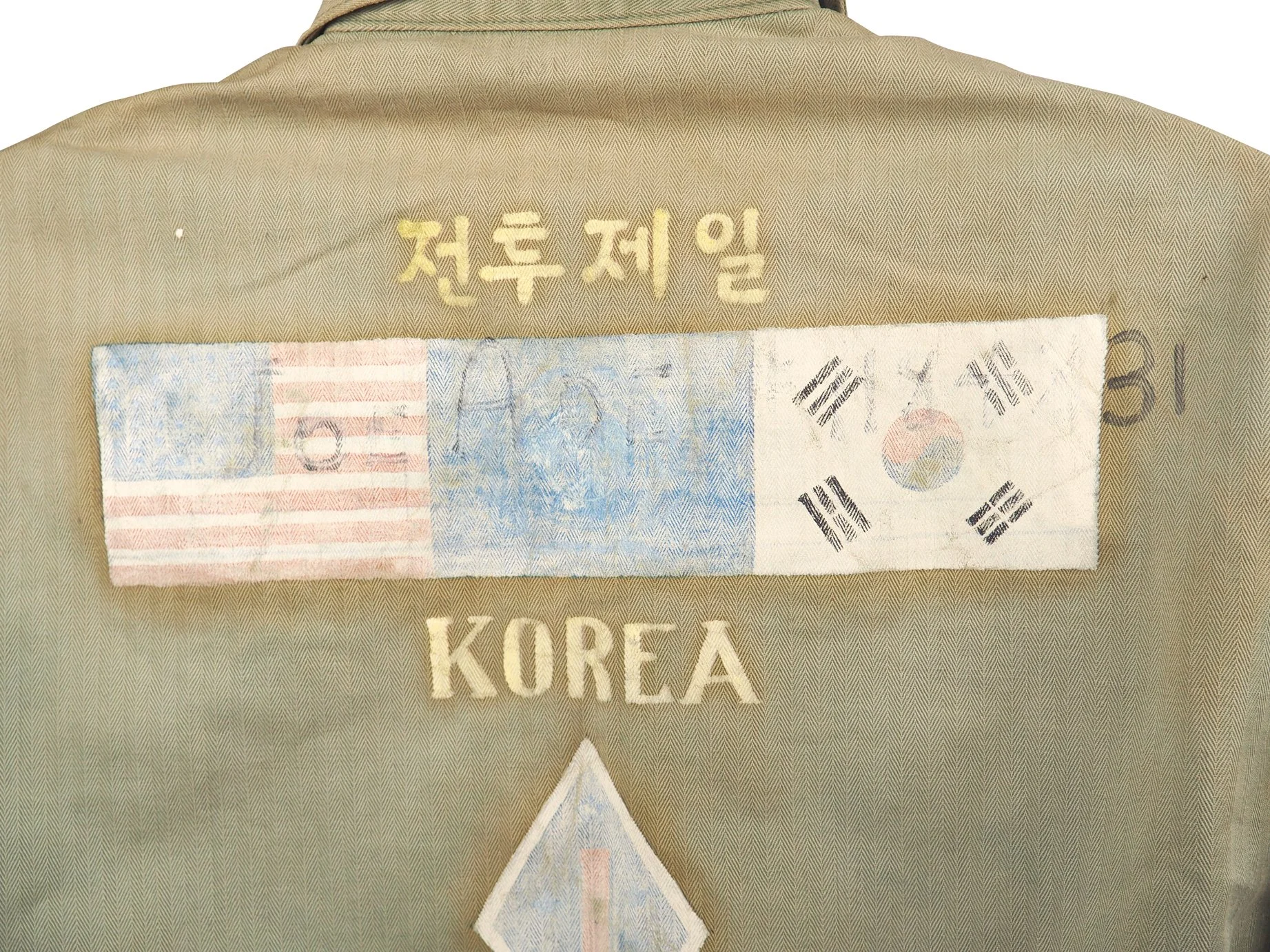
Accompanied by painted flags, the Korean text roughly translates to "Combat First" or "First in Combat" which I assume is a nod to Sgt. Ade's unit, the 1st Battalion, 1st Marines "First of the First".
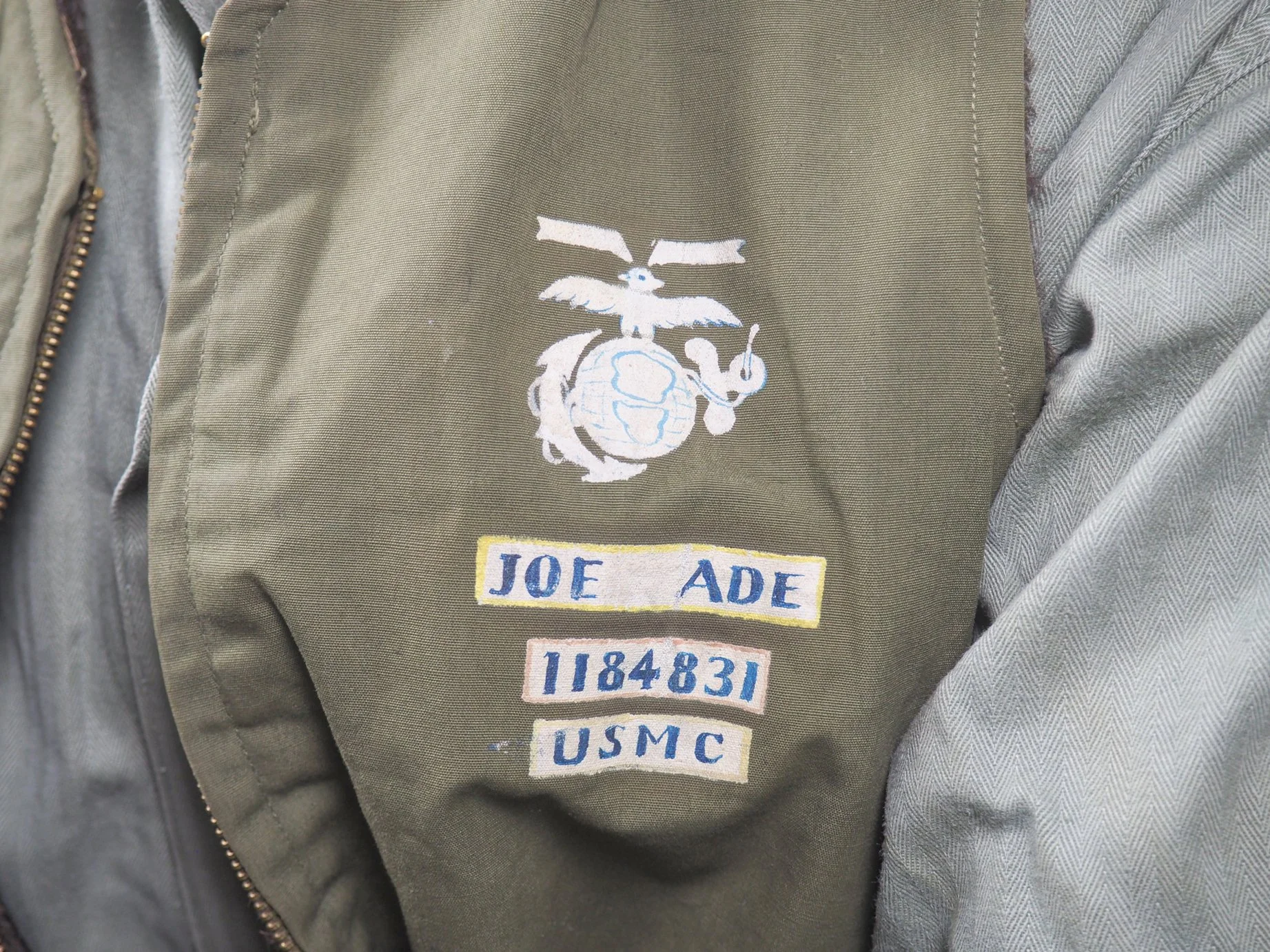
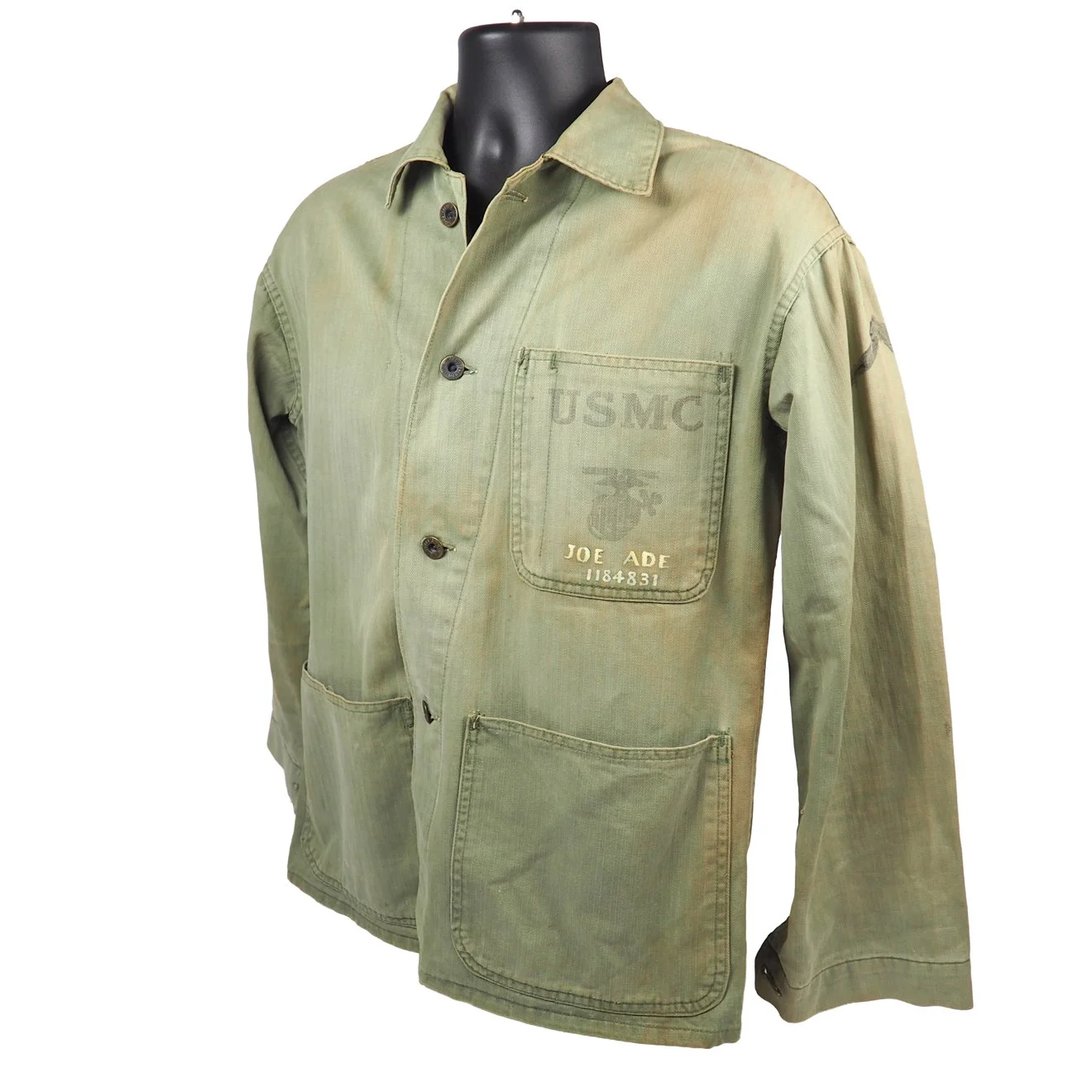
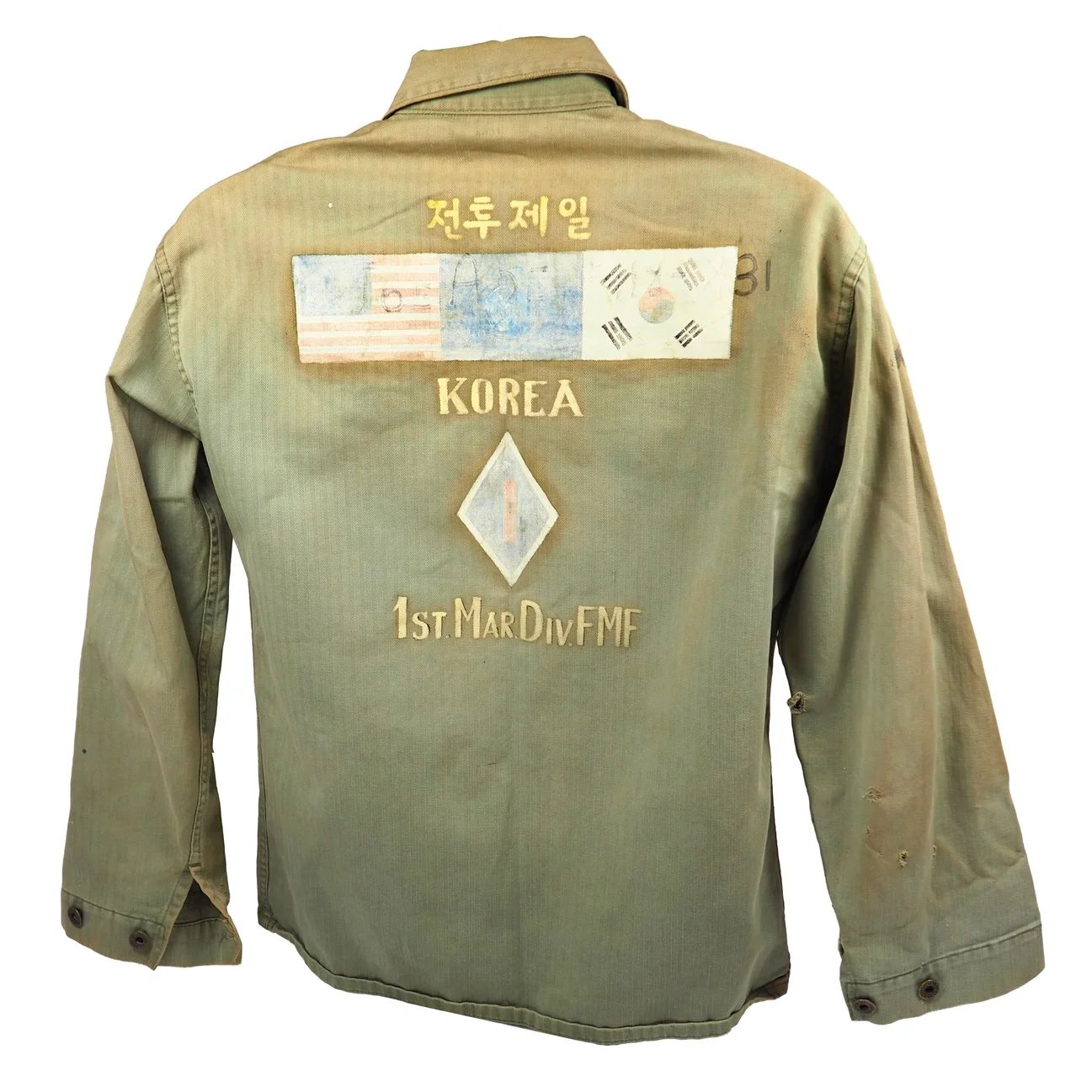
Souvenir jackets are fairly rare, and to see artwork so well done is quite incredible.
This jacket is obviously in much more worn condition than the alpaca lined vest.
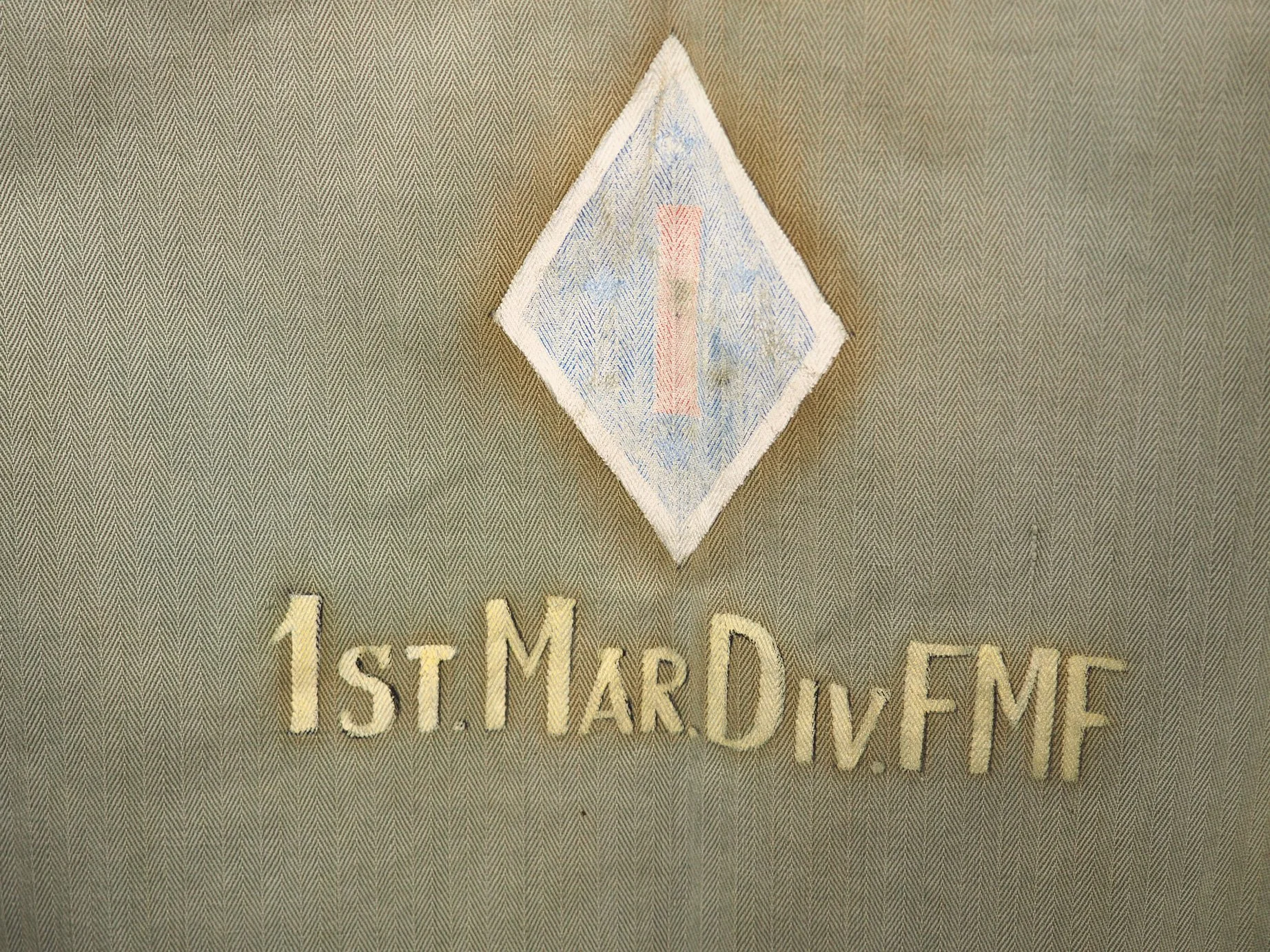
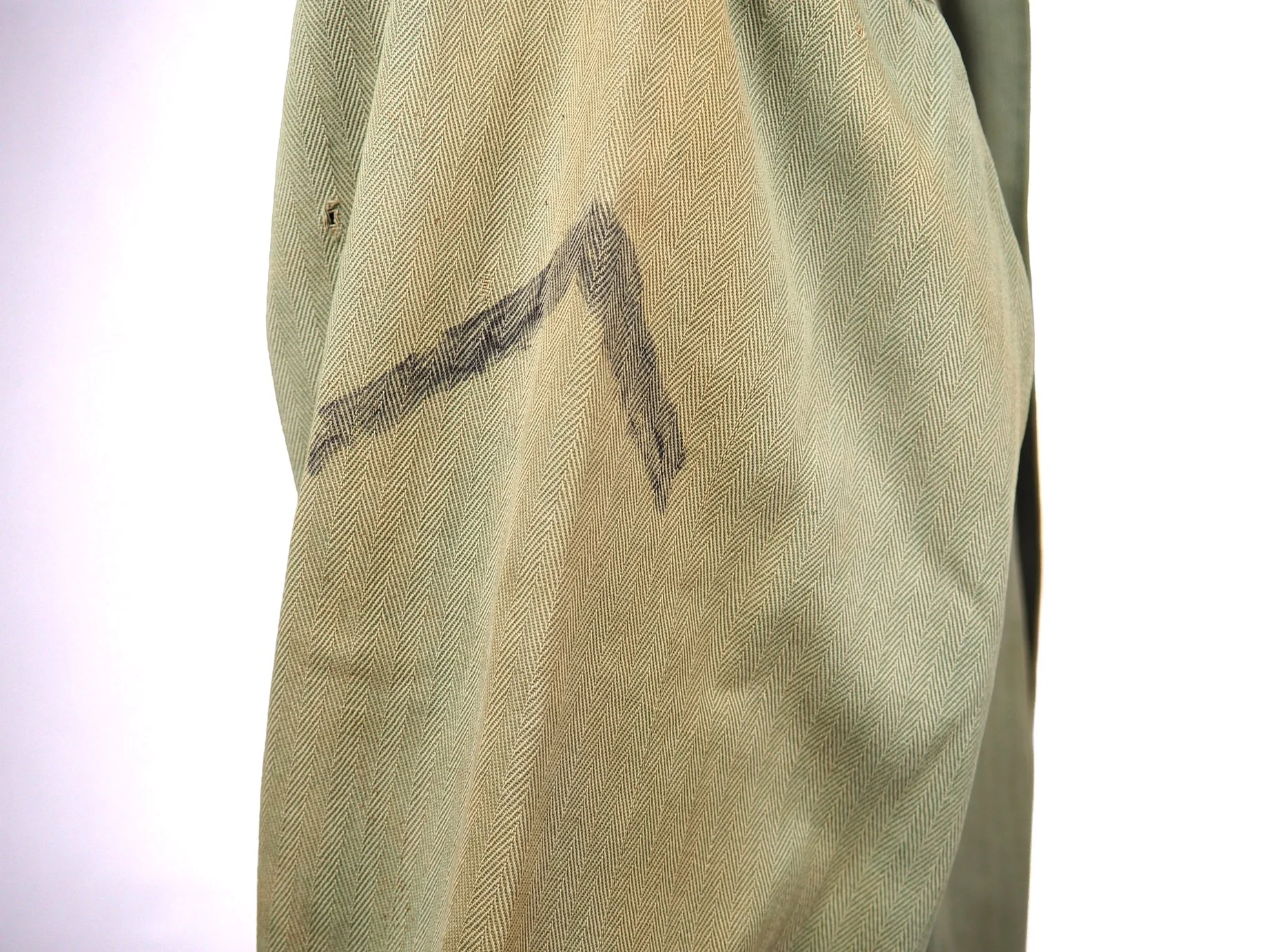
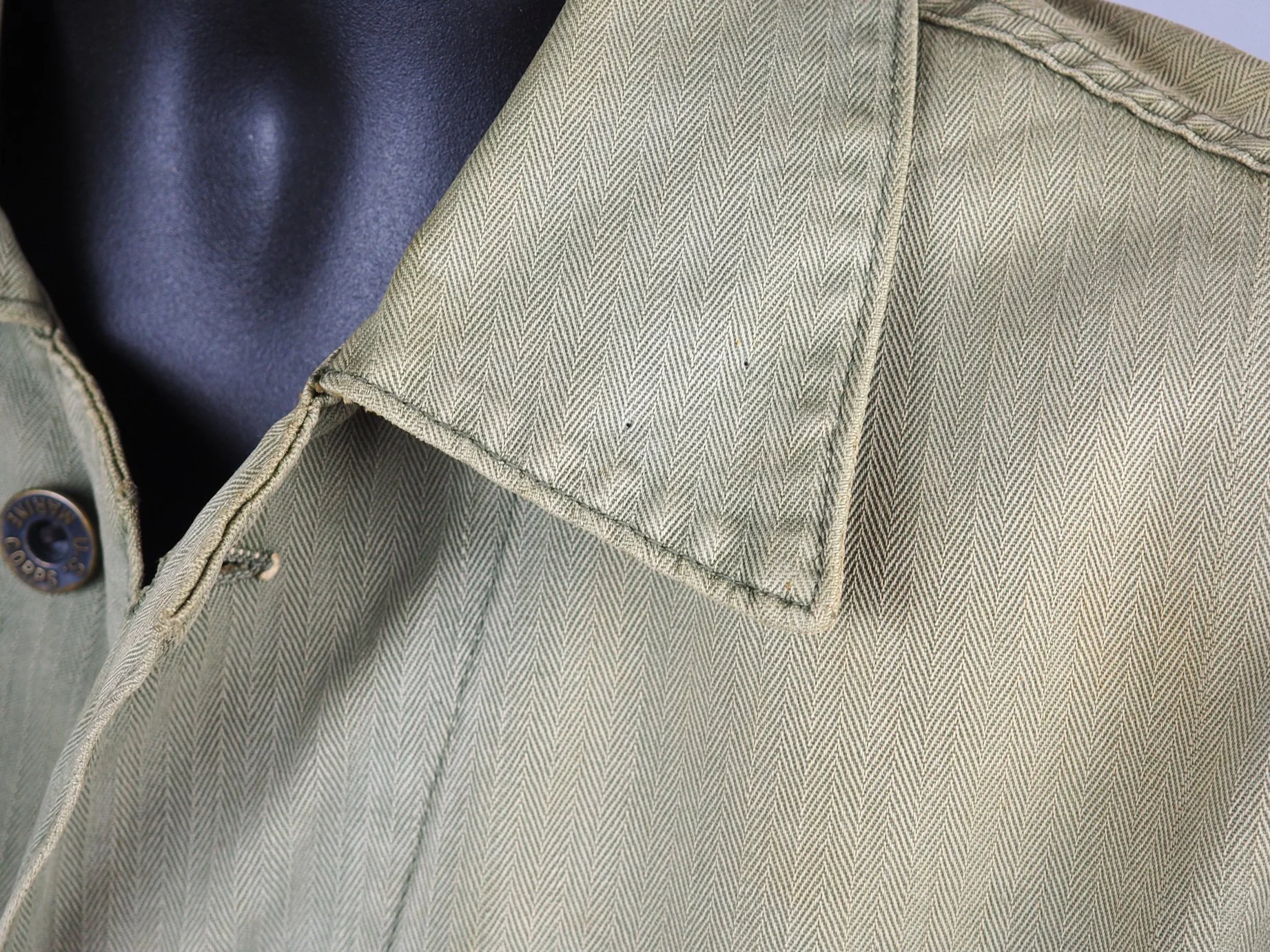
Formerly this jacket had Private First Class insignia attached.
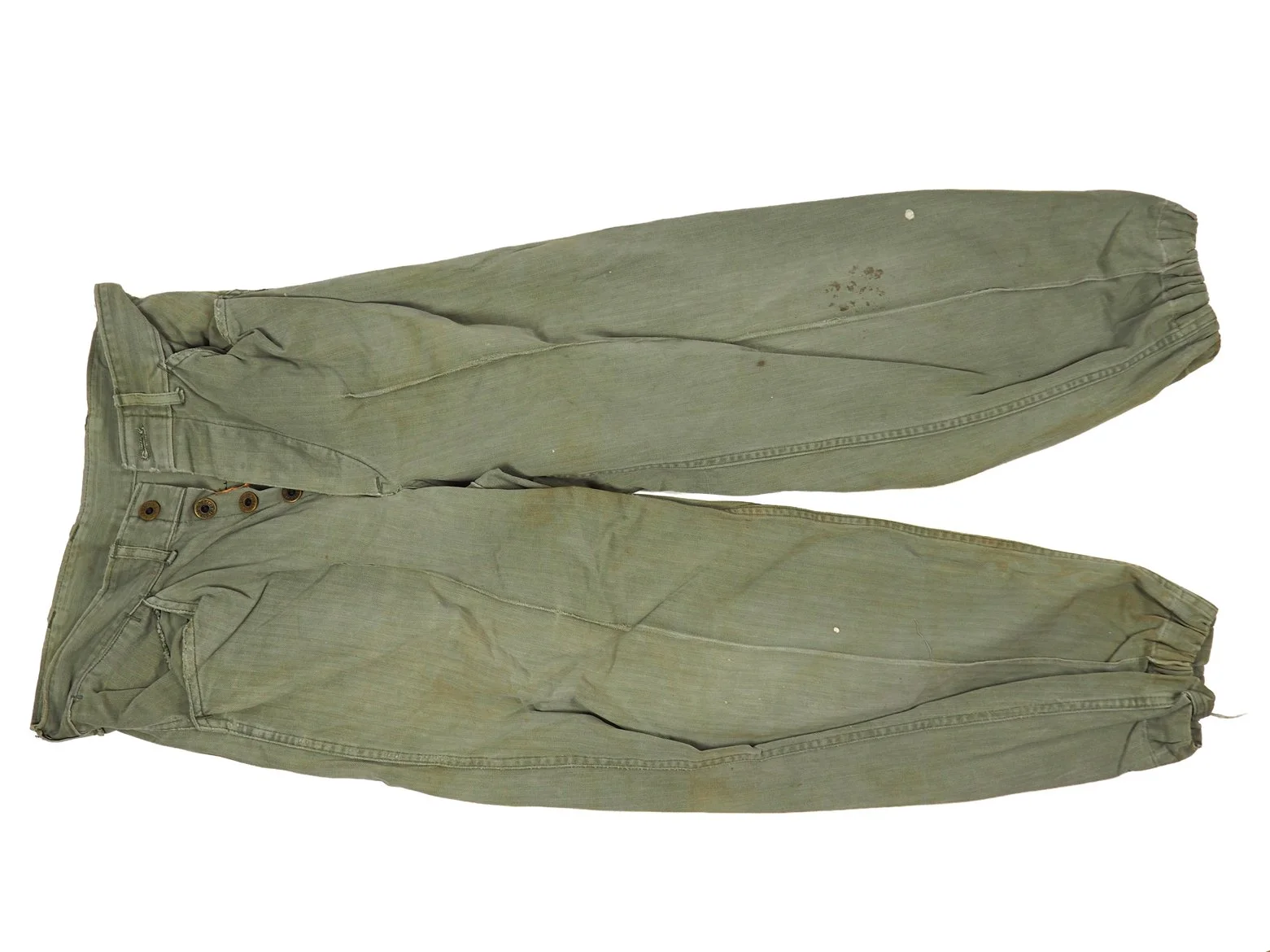
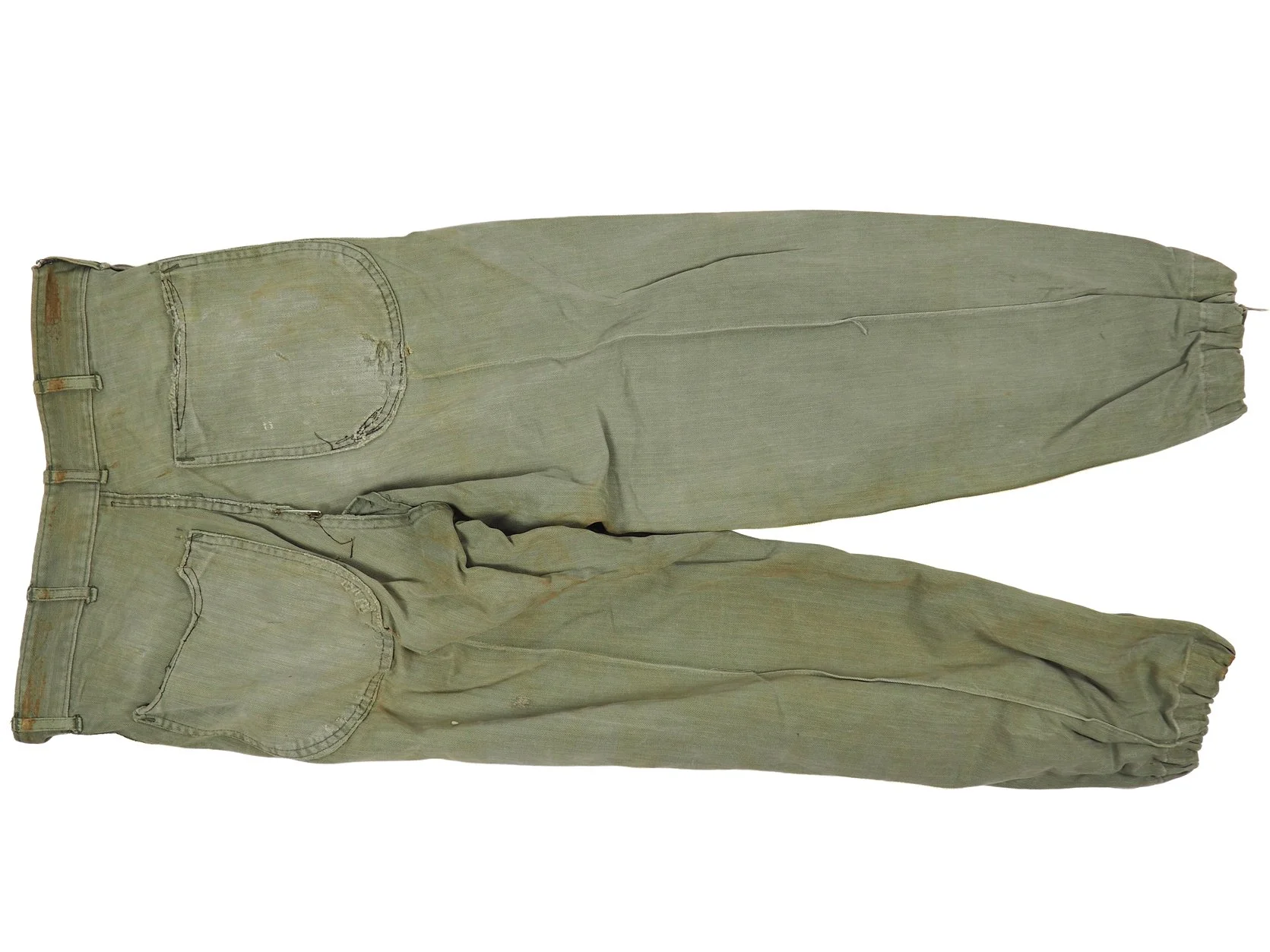
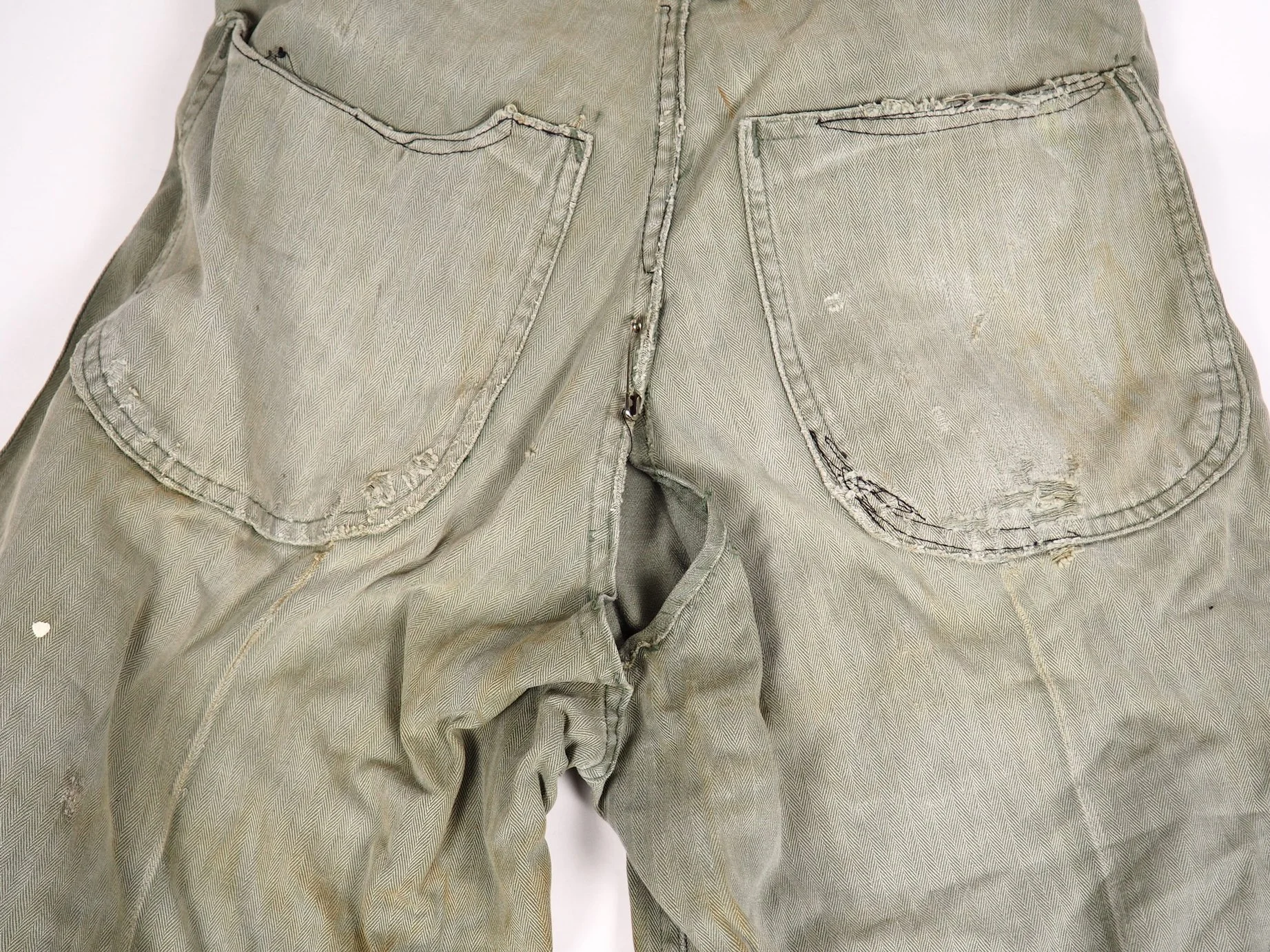
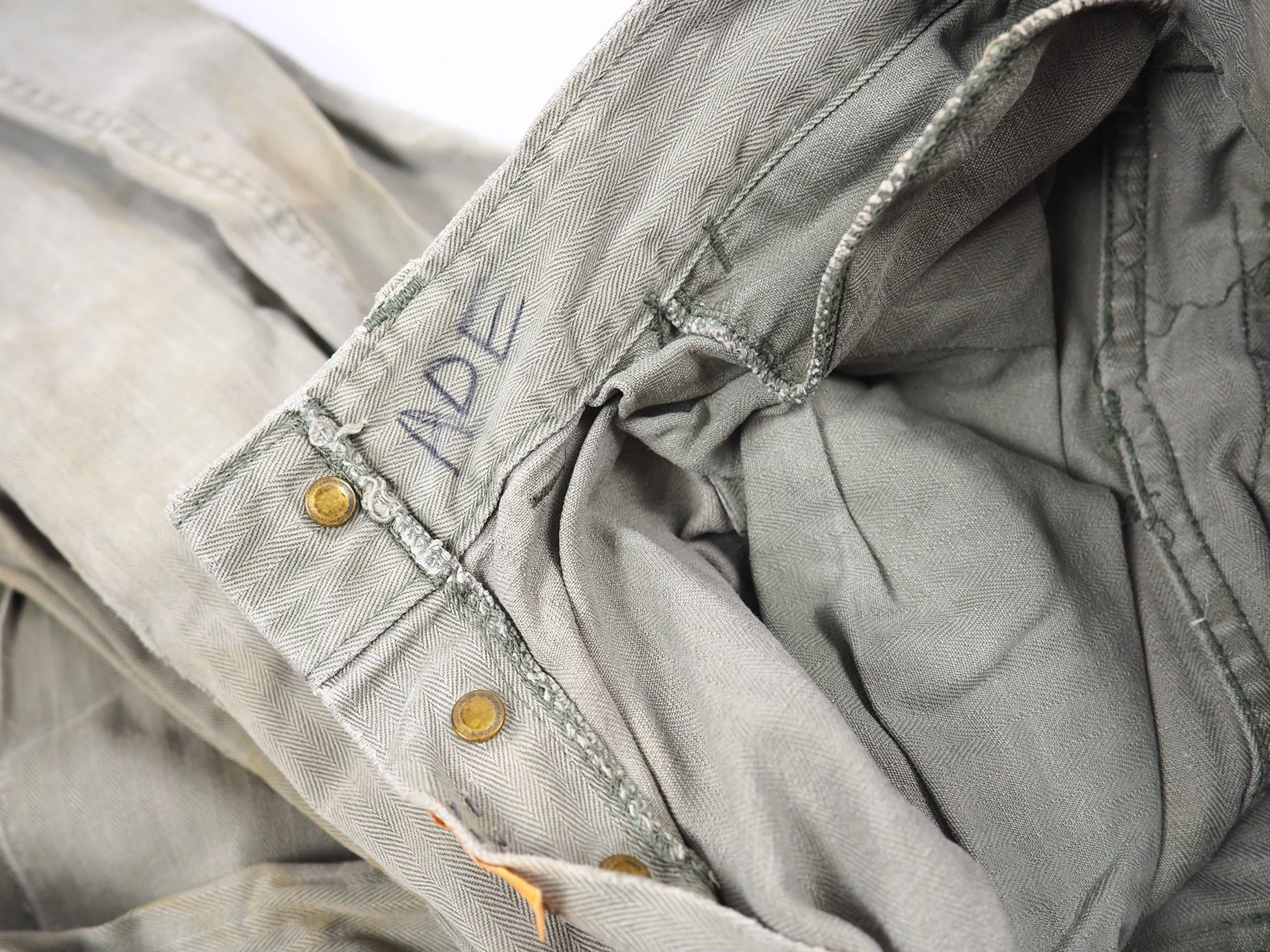
Notice that these trousers of Sgt Ade's have a split down the middle. He says in an interview this was done as an easier way for a Marine to relieve himself in the field.
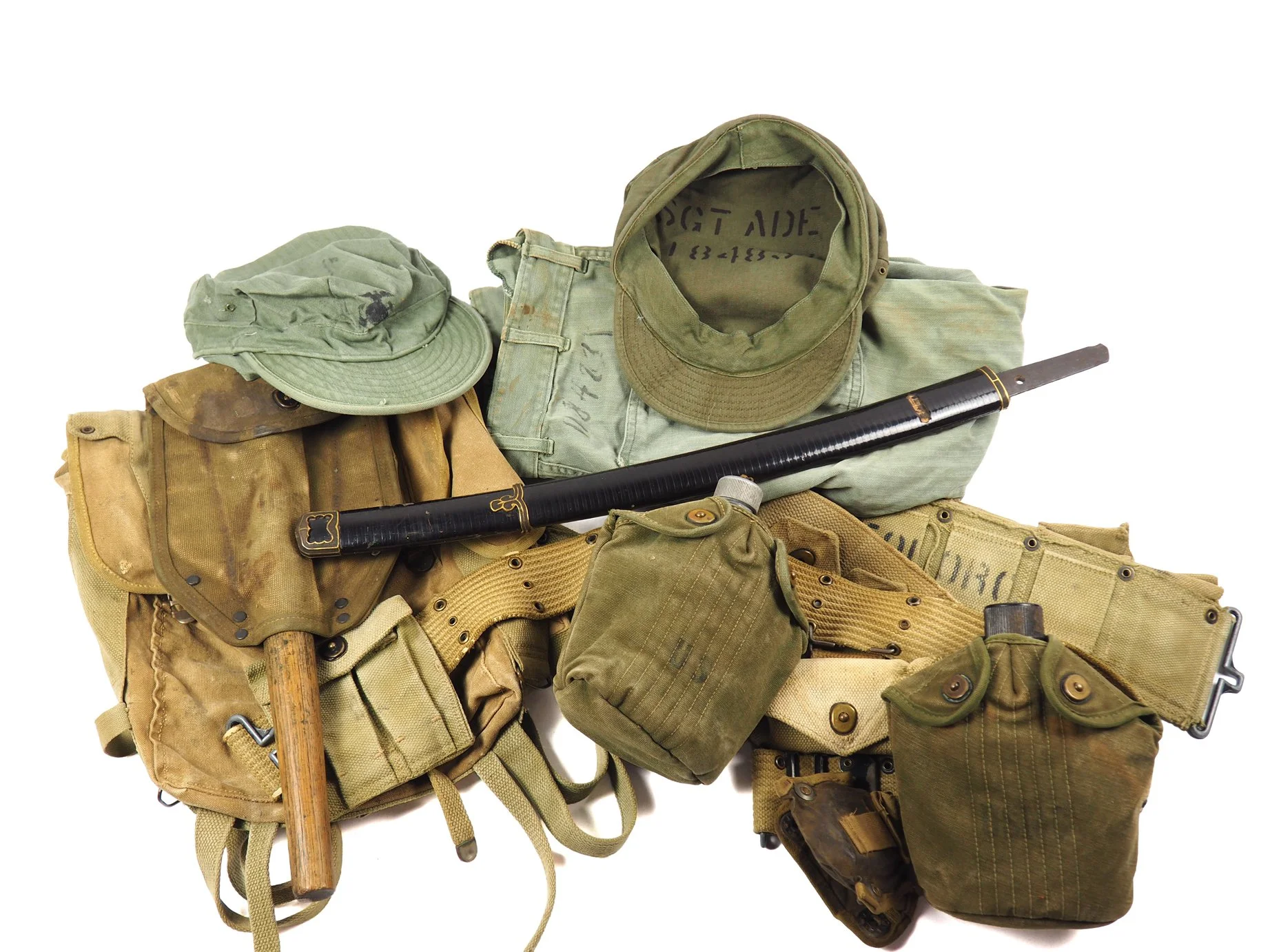
“Several pieces of Sgt. Ade’s kit, including a Chinese sword. Also of note is his shortened M1943 entrenching tool.
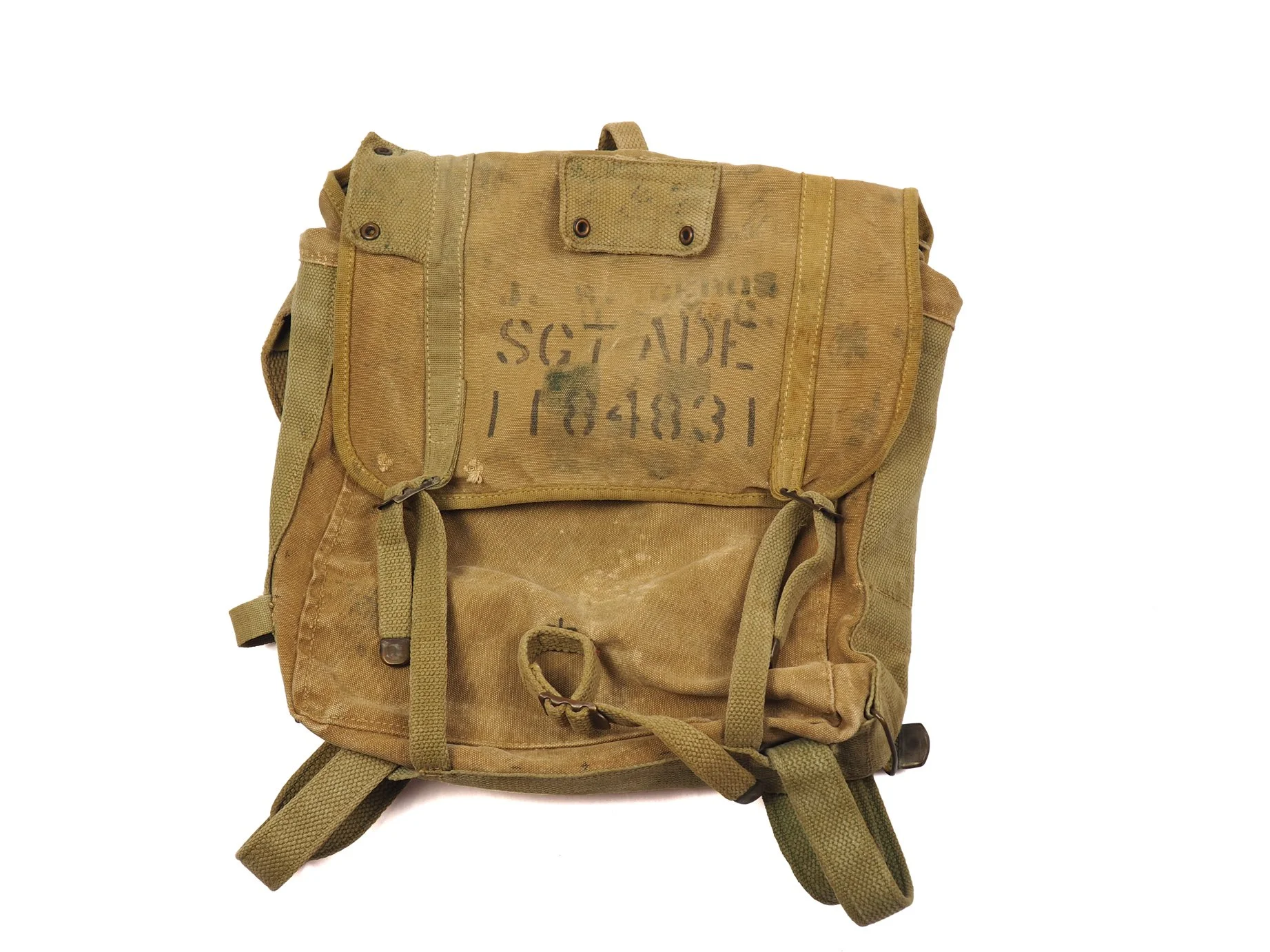
This haversack tells the story of two Marines. Faintly visible, green camouflage paint and a tactical marking for the 2nd Engineer Battalion, 2nd Marine Division can be seen.
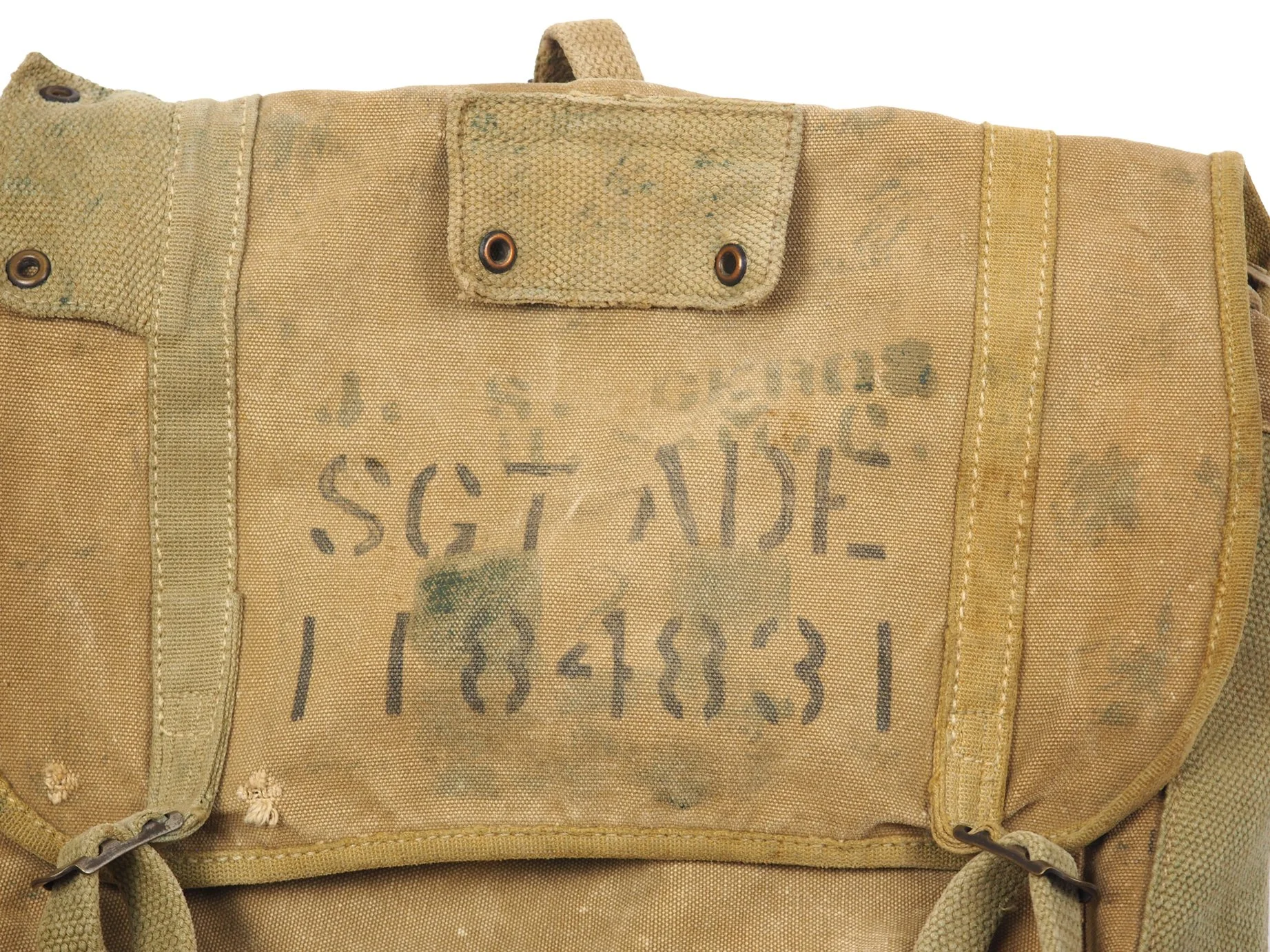
Closer examination reveals this haversack was once used by James S. Geros, 2nd Engineer Battalion, a veteran of Okinawa during World War II, where camouflage equipment was fairly common.
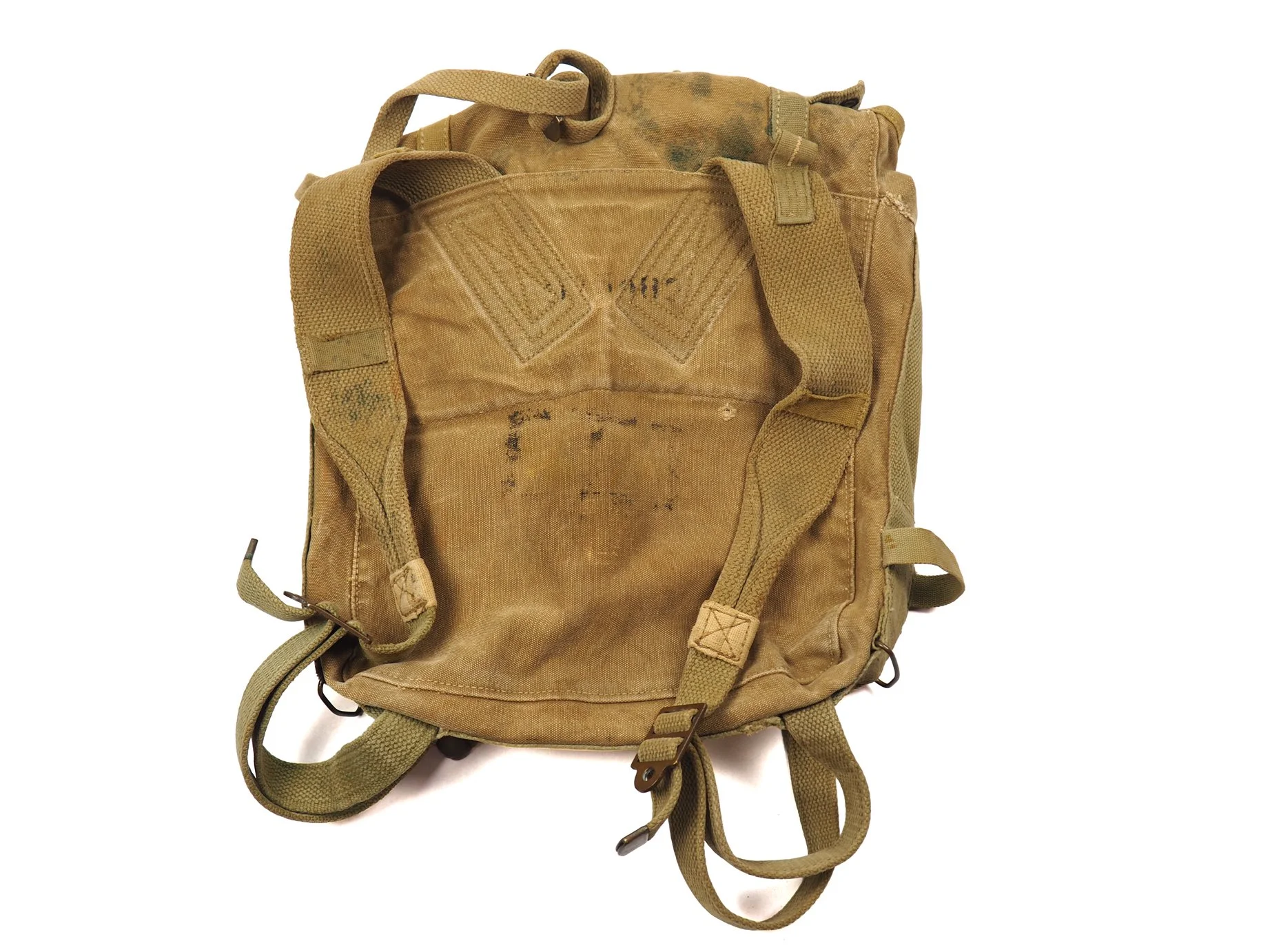
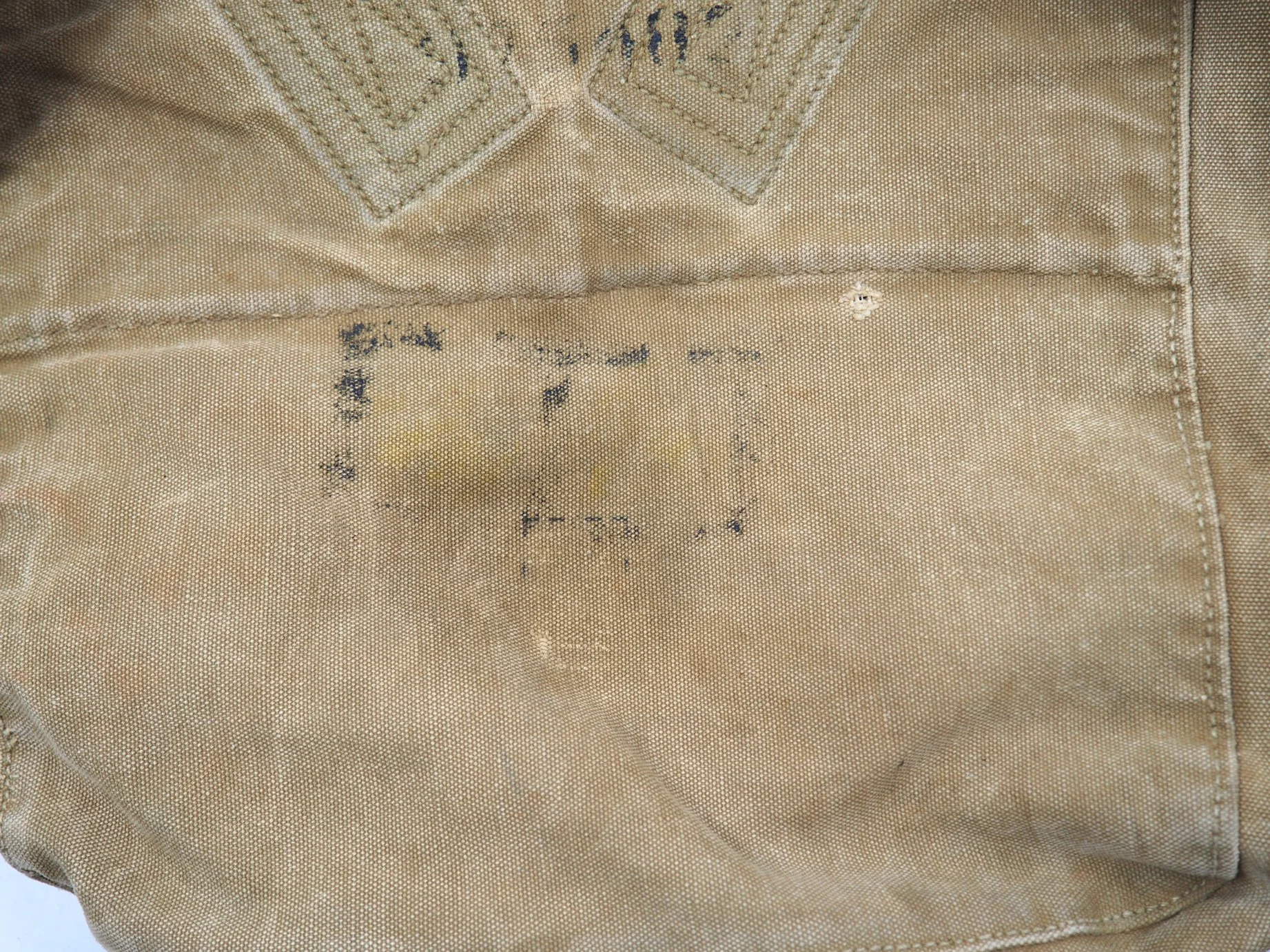
Another iteration of 2nd Engineer Battalion tactical markings, this one not camouflaged. James Geros' service number is also present.
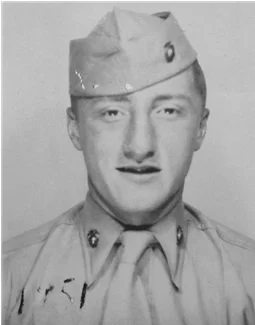
Joseph Ade was really the inspiration behind my decision to begin publishing veterans’ stories. Joe gave a fantastic interview about his time in Korea as part of the Library of Congress Veterans History Project, thanks to a New Jersey Boy Scout who organized a group of local veterans to tell their stories.
Joe talked in depth about his service, but one thing that really stuck out to me was that, unlike the modern gung-ho military mindset, he joined because he and his friend made a pact: if one of them was drafted, they would join together. In fact, he didn’t even want a combat arms role and went to the Navy and Air Force first since he figured that would be the safest route. Yet, Joe and his friend stopped by the recruiting office of the Marines after being turned away by the Navy. In his words, they did have some great looking uniforms.
Joe was born in Atlantic City, New Jersey, growing up at the beach because his father was a janitor right near the boardwalk. He moved around for the majority of his young life, both his parents working to help the war effort of World War II until he enlisted in the Marine Corps in 1951. Joe completed his Advanced Infantry Training without obtaining an MOS, and he went home on leave only to get orders to the 14th Replacement Draft destined for Korea.
He shipped to Japan and stayed for a few weeks, where the Corps claimed he would in fact receive more formal training, yet, he joined Company B, 1st Battalion, 1st Marine Regiment on November 7th, 1951 without any proper infantry training. At the time, 1/1 was in defensive posture at Hill 812 on the Minnesota Line, and hill 812 held strategic positioning overlooking a road and the DMZ. Hill 812 was previously captured the month before by the 1st Marines.
On his very first night with the unit, Joe went on a patrol. At this point in the war, peace talks were continuing, and the 1st Marine Division was ordered to reinforce positions and authorized only to “regain key terrain lost to enemy assault”. Given the static nature of the war, patrolling on both the North Korean and UN side was common.
Joe describes his first day on the front as being crippled with fear. Upon exiting the truck to join his unit, he saw a dead Marine being removed from the line. In the early morning hours of November 8th, Joe’s patrol would step off across the Baker Company line, distant artillery shaking the earth, and flares casting their glow on the vast emptiness ahead.
Joe was ordered to hold a position down a hill by his Lieutenant while out on the patrol. Joe immediately slipped down the hill like a greased pig on the wet slope and crushed his groin at terminal velocity on a tree that was strategically placed between his legs. So there Joe sat, wet, cold, afraid, and probably in a good deal of pain. After sitting for a while, he heard someone quietly call “Joe”. His thoughts backtracked to the World War II film he had seen as a boy, Guadalcanal Diary, where a Japanese soldier lures a Marine to his death by calling out “Joe” in the middle of the night. Joseph Ade froze in fear and didn’t say a word. The voice stopped calling, and after about 15 minutes, he heard it again. Finally, Joe recognizes the voice of his Lieutenant, this time screaming his name along with a few choice words.
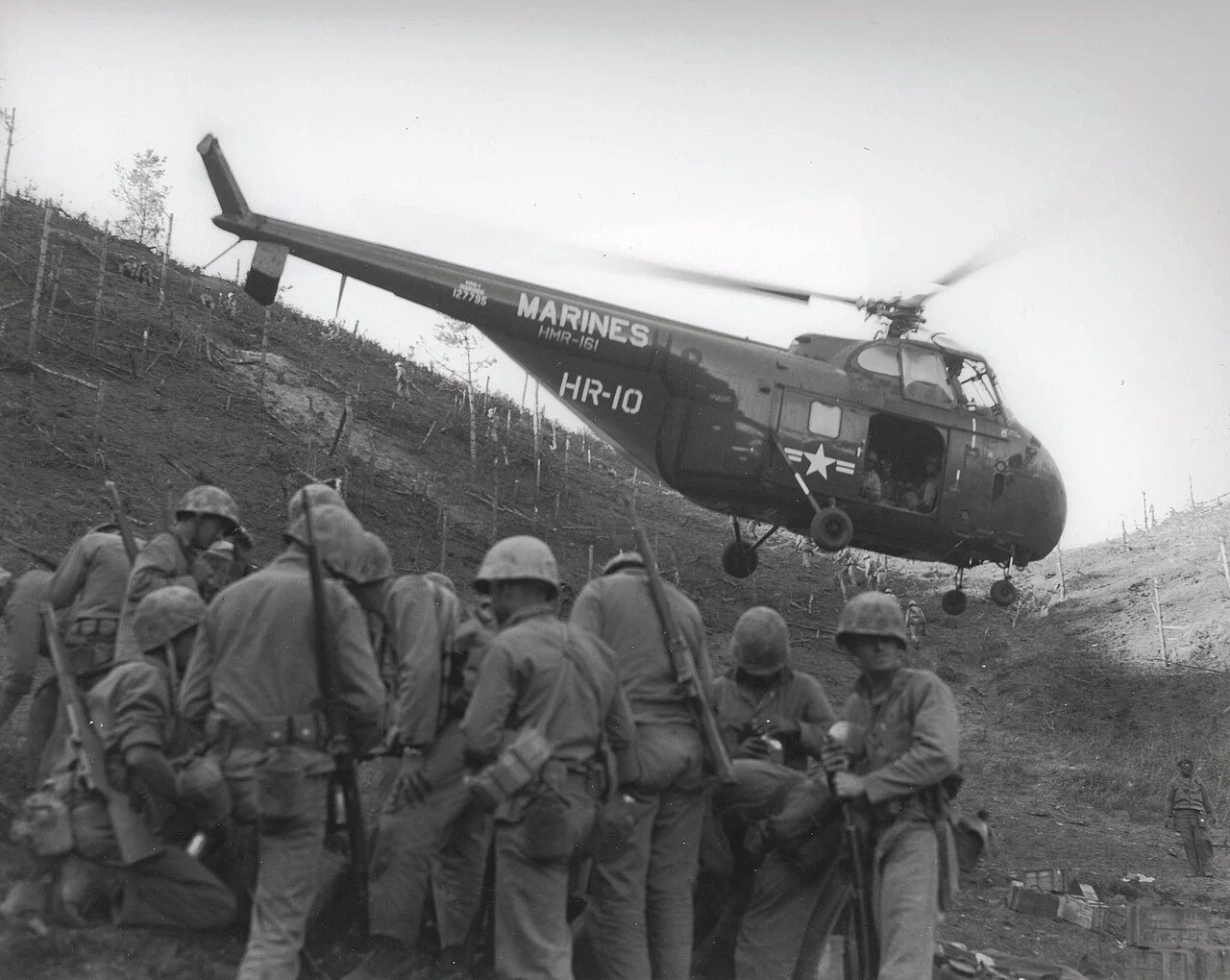
With the advent of the helicopter, moving men around the rough terrain was made much simpler and would change how warfare was conducted in the coming years. The maps below show the area where Joe Ade took his first helicopter ride off the Minnesota Line aboard a Sikorsky HRS-1.
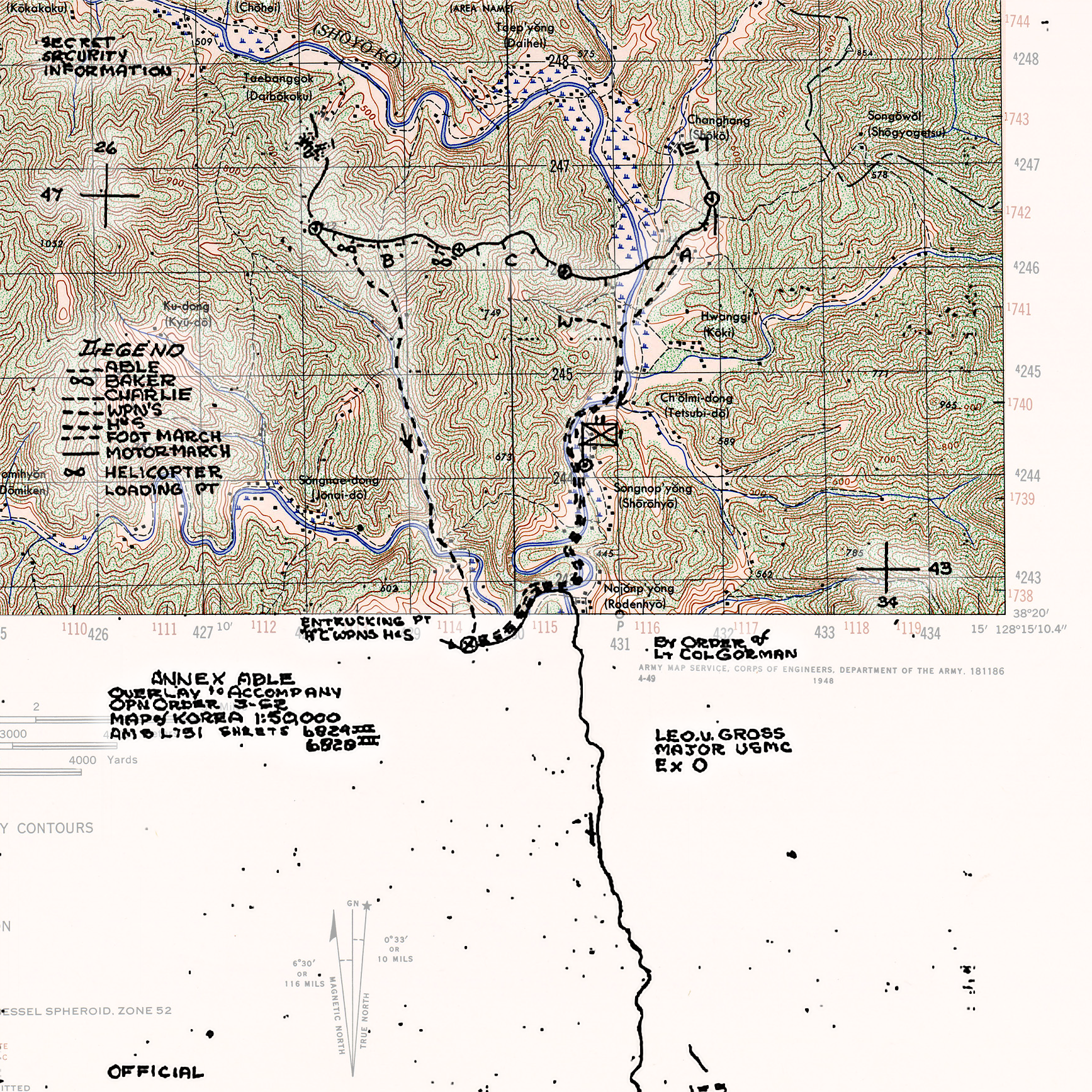
A reconstruction of Baker 1/1's Position while Joe was there. The position of Baker Company at this time was Hill 812, which was bitterly fought over and captured by Marines a month before Joe joined the unit. This map was created using a 1/1 map overlay from January 1952 and a copy of the map it was overlaid upon. This specific overlay exhibits 1st Battalion exiting the DMZ towards the rear, B Company moving by helicopter as seen on the legend.
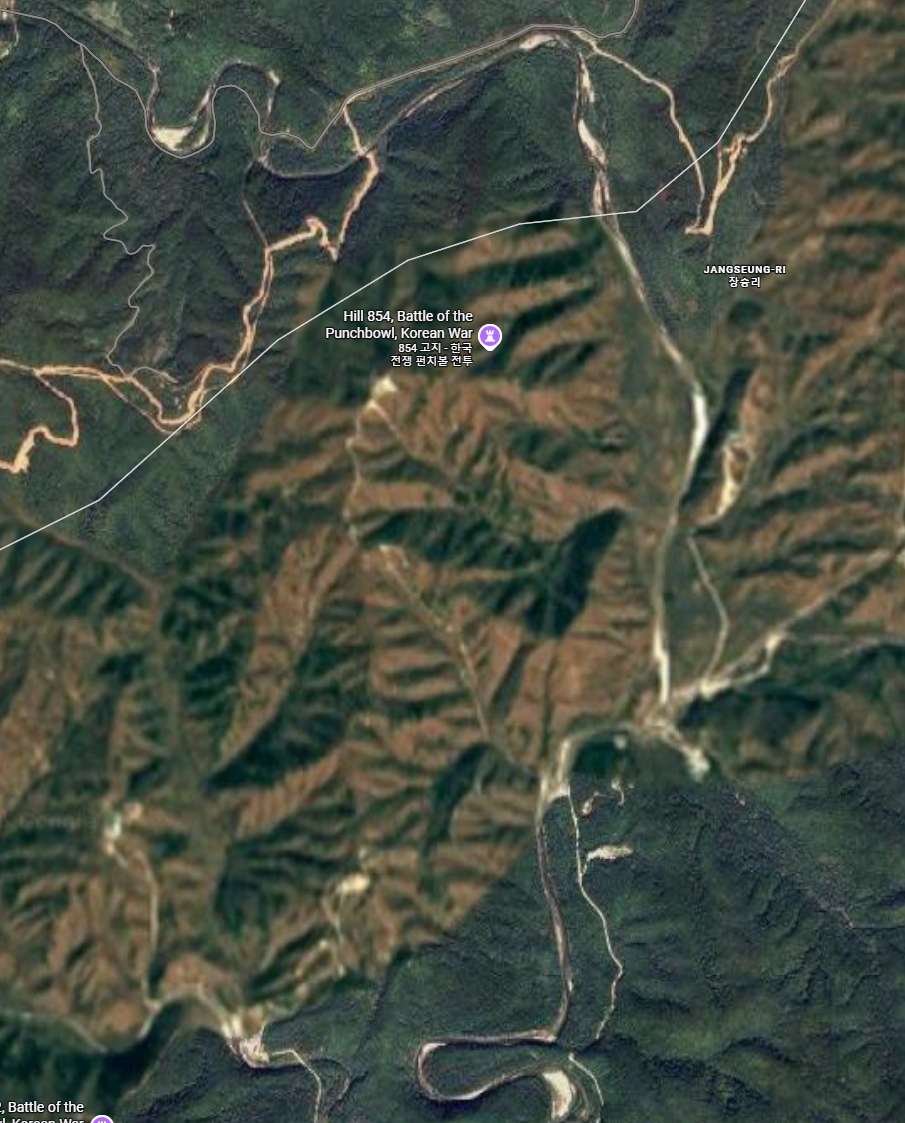
The area as observed as it appears today on google maps. Everything north of the white line is now North Korea.
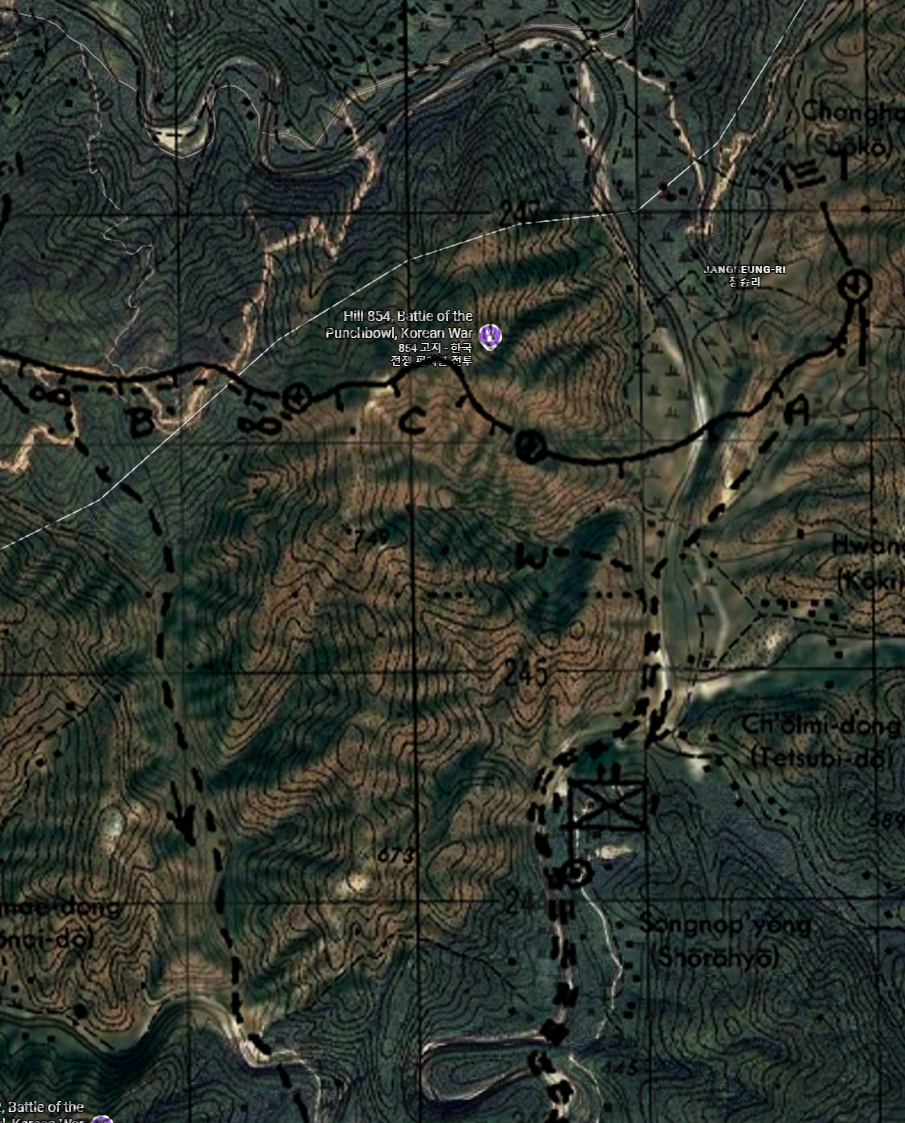
Map I constructed overlaid on google maps screenshot.
Thanks to Joe’s last name, he was often selected as the guy to do things since his name was always the first one on the morning reports, and he credits this for the reasoning for his next job assignment. It would be on Hill 812 when Joe became a sniper - and as Joe recalled in his interview, sniping back in the day was nothing like what it is now. There was no rigorous training, no teachings on the science of ballistics, just give a Marine who hadn’t had formal infantry training a scoped rifle and let him have it.
To be completely frank, the scopes of the era were archaic compared to what we have now and even compared to some other models of the era. Joe states that he first started with a scoped M1903 Springfield rifle, which was destroyed, and then he was issued a scoped M-1C Garand as seen in the photo. His primary goal was to harass the communist forces when they left their positions to repair damage from the artillery fire. Not only did he use the aforementioned rifles, but he was also issued the highly effective M-3 “Snooper” Carbine which was the first weapon with night vision to be widely used. The M-3 Carbine was capable of fully automatic fire and equipped with a gigantic infrared scope, powered by a 15 pound battery that made the weapon useful at night up to about 100 yards.
Joe’s original rifle range score book from Parris Island. It is remarkable to think that he was just qualifying with a rifle in May of 1951, and he would be in combat only 6 months later. While he had no formal sniper training, one could infer from this that he was cut out for the job.
While some of his time out in Korea was filled with exciting moments of sneaking around and taking well placed shots at the enemy, the majority of combat is a lot of sitting around in the mud and rain, and in this case being cold. The men of 1/1 would mostly sit at their fighting positions surrounded by barbed wire with strung up ration cans, keeping an eye on the line, and as Joe recalls, relieving themselves in ration boxes and setting them out to freeze over night for later disposal. But again, sometimes there is excitement.
Joe recalled a night during Operation Clam Up in February of 1952 where a squad sized Chinese patrol had been observed crossing over into the B Company line thinking the Marines had withdrawn. The Marines maintained strict fire discipline as the Chinese squad continued to move closer and closer, until they reached to within 10 yards of the B Company positions. A friend of Joe’s had wiped out the entire squad minus two with a 30 caliber machine gun. Joe was in entirely too close of proximity to this event, and looking out into the darkness, he saw a swift arm motion shimmer under the night sky.
“And I hear a thud on my sandbag, and I turn my Browning automatic, and I get off about three rounds and the next I knew, I’m blown back into the trench, and the next thing I knew I’m in the platoon command post ready to be medevaced down.”
On that night in February of 1952, Joe traded blows with that Chinese soldier. The Chinese soldier would in fact be wounded by Joe’s BAR fire, and Joe received grenade shrapnel to his eye. A Navy doctor meticulously and successfully removed the fragments and treated the wound. Joe was disappointed to learn that he would not be returning home and rejoined Baker Company shortly after receiving the wound.
In May of 1952, Joe’s vividly recalled his last day in Korea. While bidding farewell to his fellow Marines, his squad came under intense Chinese fire while Joe was waiting for the jeep to arrive to take him to the rear. His platoon leader coordinated ambulances to head to the front, ordering Joe to stay in the rear and sit this one out - it was his last day on the front after all. The jeep arrived, and Joe hopped in to direct the driver to the casualties. The pair arrived on scene to the chaos of dead and wounded strewn about from both the Chinese and Marines alike, but there was still combat in the area. Another Baker Company Marine encountered a Chinese soldier who suddenly emerged from a bunker firing his ‘burp gun’ and was immediately cut down by the Baker Company Marine.
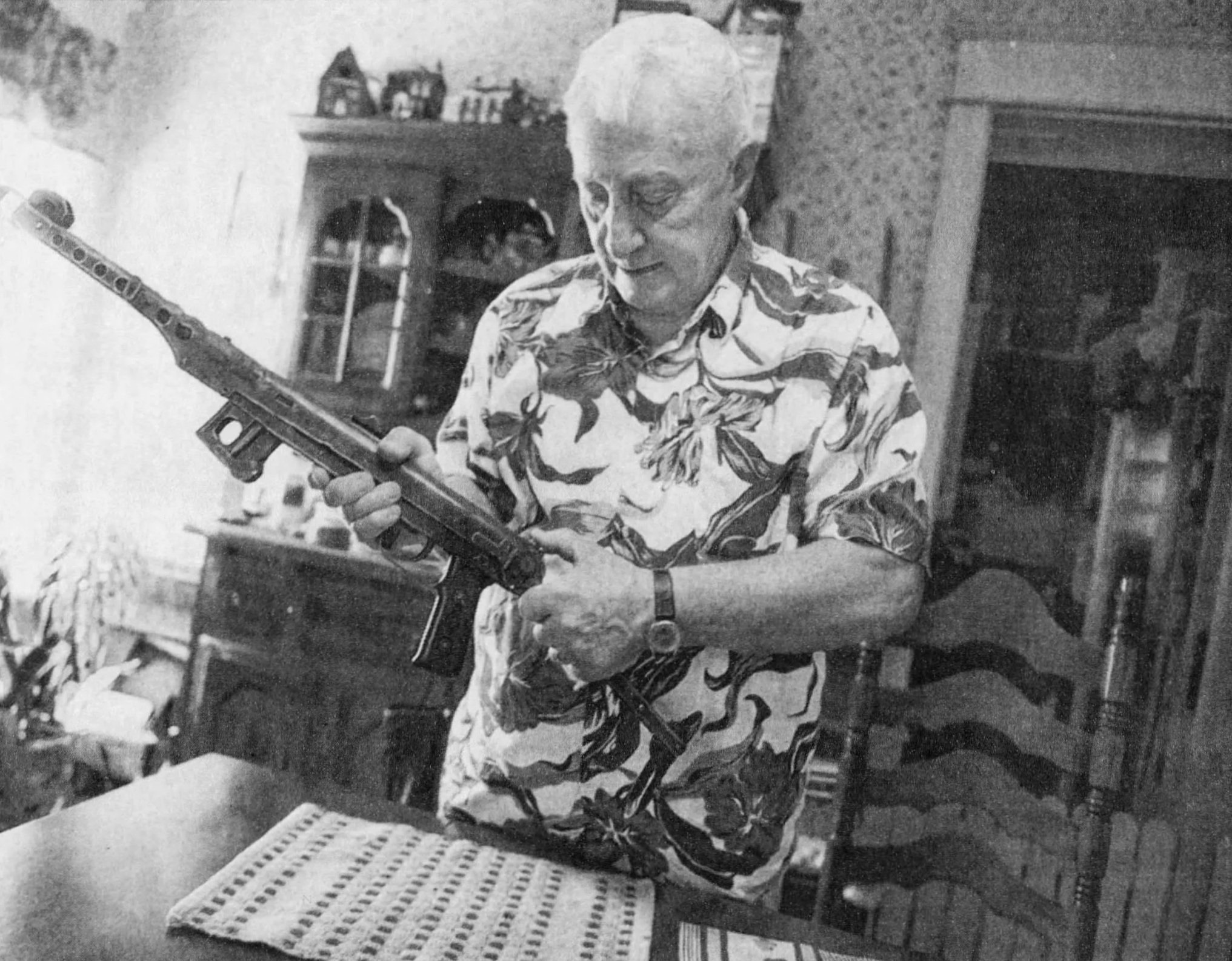
It was in this area that Joe scavenged a Burp Gun from the battlefield. He is pictured here, decades later, with his captured “Burp Gun”, or in this case, a Chinese Type 54 submachine gun. The weapon had been close enough to an exploding shell that its barrel was bent, rendering it unusable. Joe stuffed it into his seabag, where the weapon would be brought all the way back to New Jersey.
Joseph Ade returned home from the Korean War with a Purple Heart and the Korean Service Medal with campaign awards for the UN Summer-Fall Offensive and Second Korean Winter. He remained in the Marine Corps Reserves reaching the rank of Sergeant until he departed the Corps in 1956. Like many veterans, he would utilize the GI Bill and go to college, ultimately becoming a successful realtor in his later years. He joined the VFW and remained very active in the veteran community for the rest of his life, going so far as to help raise money for local Iwo Jima veteran John Lauriello to return to the hallowed battlefield.
Joseph Ade passed away in March of 2025. I am eternally grateful that he decided to share his story, and that I am able to present his artifacts as a small representation of his life. Below I have embedded his entire recording of Joseph Ade’s Veterans History Project Interview, and I recommend listening to it as it gives you an idea of what kind of man he was.